
Can a 2,000-Watt Generator Run an RV Air Conditioner?
Can You Run an RV Air Conditioner on a 2,000-Watt Generator?
It is one of the most common questions RV owners ask when shopping for a portable generator:
Can a 2,000-watt generator run my RV air conditioner?
The answer is:
Sometimes.
And the reason the answer is not a simple yes or no comes down to the difference between starting an air conditioner and keeping an air conditioner running.
A generator may have enough power to operate an RV air conditioner after the compressor is running but still struggle—or completely fail—to start the compressor.
That is where an RV air conditioner soft start can make a major difference.
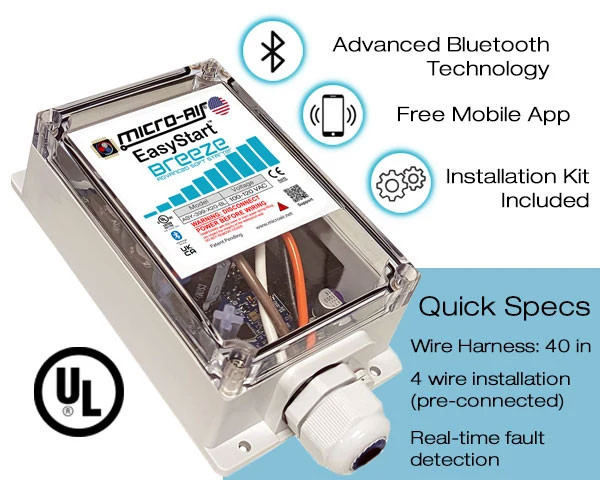
A product such as the Micro-Air EasyStart Breeze is designed to reduce the large electrical surge that occurs when the air conditioner compressor starts. In some RV setups, that reduction can make the difference between a generator successfully starting the air conditioner and immediately going into overload.
But a soft start is not magic, and it does not turn a small generator into a large one.
Understanding what it actually does will help you decide whether a 2,000-watt generator and soft start make sense for your RV.
Why RV Air Conditioners Are Hard to Start
An RV air conditioner has several electrical components, but the compressor is the big one.
Once the compressor is running, its electrical demand is relatively predictable.
Starting it is different.
When the compressor first turns on, the motor can momentarily draw considerably more current than it requires during normal operation.
This is often called:
-
Startup surge
-
Starting current
-
Inrush current
-
Locked rotor current
That initial surge only lasts a short time, but it can be enough to overload a smaller generator.
This explains a situation many RV owners have experienced:
The generator starts normally.
The RV has power.
The air conditioner fan comes on.
Then the compressor tries to start.
The generator bogs down, overloads, or shuts off.
The problem may not be that the generator cannot run the air conditioner.
It may be that the generator cannot handle the short burst of power needed to start it.
Running Watts and Starting Watts Are Not the Same
When comparing an RV air conditioner to a generator, you need to think about two different power requirements.
Running Power
This is the electrical power the air conditioner needs once the compressor is operating normally.
Starting Power
This is the brief surge required to get the compressor motor moving.
A generator may have enough continuous wattage to handle the running load while still lacking enough surge capacity for startup.
That distinction is extremely important when people say:
“My air conditioner only uses around 1,500 watts, so a 2,000-watt generator should run it.”
Maybe.
But if the compressor requires a much larger burst of power during startup, the generator still has to survive that initial demand.
What Does an RV AC Soft Start Do?
An RV air conditioner soft start changes the way the compressor starts.
Instead of allowing the compressor to demand a large amount of current almost instantly, the soft start electronically controls the startup process.
The result is a smoother compressor start with significantly less starting current.
The Micro-Air EasyStart Breeze, for example, is designed to reduce compressor startup current by up to 75%.
That can make it much easier for a generator or inverter to start an RV air conditioner.
It can also reduce the familiar:
THUMP
that often happens when an RV air conditioner compressor kicks on.
What a Soft Start Does NOT Do
This is where some RV owners get confused.
A soft start does not dramatically reduce the power required to keep the air conditioner running.
Its primary job is reducing the starting surge.
For example, if your RV air conditioner requires substantial continuous power once it is running, installing a soft start does not suddenly turn it into a low-power appliance.
Your generator still has to supply enough continuous wattage for:
-
The air conditioner compressor
-
The air conditioner fan
-
The RV converter
-
Battery charging
-
Refrigerator
-
Television
-
Other electrical loads operating at the same time
The soft start simply helps get the compressor through the hardest part:
startup.
So Can a 2,000-Watt Generator Run an RV Air Conditioner?
In some RV setups, yes.
A 2,000-watt-class inverter generator paired with an air conditioner equipped with a quality soft start may successfully run certain RV air conditioners.
But there are several variables.
Air Conditioner Size
A smaller rooftop air conditioner will generally be easier for a generator to operate than a larger one.
Common RV air conditioner sizes include:
-
11,000 BTU
-
13,500 BTU
-
15,000 BTU
Do not assume BTU rating alone tells you exactly how much electrical power the unit requires. Different air conditioners can have different electrical characteristics.
Always check the manufacturer's electrical specifications.
Generator Ratings Can Be Misleading
Another thing to watch is the way generators are marketed.
A generator advertised as a 2,000-watt generator may not actually provide 2,000 watts continuously.
It might have:
-
2,000 starting watts
-
1,600 or 1,800 running watts
The larger number printed on the generator is often the peak or surge rating.
For an RV air conditioner, the continuous output rating matters just as much.
Always check both numbers:
Maximum or surge watts
and
Continuous or rated watts
Other RV Loads Matter
Even if the generator can run the air conditioner by itself, other electrical loads can push it over the limit.
One of the most commonly overlooked loads is the RV converter.
If your batteries are discharged when you start the generator, the converter may immediately begin charging them and place a significant load on the generator.
Then you turn on the air conditioner.
Now the generator is powering both.
Other high-demand appliances include:
-
Microwave
-
Electric water heater element
-
Hair dryer
-
Coffee maker
-
Toaster
-
Electric fireplace
-
Residential refrigerator
-
Battery charger
-
Portable electric heater
When using a smaller generator, load management becomes important.
You may need to turn certain appliances off while the air conditioner is operating.
Elevation Can Reduce Generator Performance
This is especially important for RVers who camp in the mountains.
As elevation increases, naturally aspirated gasoline engines generally produce less power because the air becomes thinner.
That means a generator that handles your air conditioner perfectly at low elevation may struggle at a mountain campground.
Temperature can also affect performance.
A generator operating at high elevation on a hot afternoon may have considerably less usable capacity than it did under ideal conditions.
At the same time, your air conditioner may be working harder.
That combination can make a marginal generator setup stop working.
Hot Weather Makes the Air Conditioner Work Harder
An RV rooftop air conditioner sitting in direct sunlight on a 100-degree afternoon is operating under much more difficult conditions than it is on a mild 75-degree morning.
Higher temperatures can increase compressor load and electrical demand.
This is another reason a setup that works during testing at home may behave differently while camping.
When sizing a generator, leave yourself some breathing room whenever possible.
Generator Eco Mode Can Affect AC Startup
Many inverter generators include an economy or Eco mode that allows the engine to slow down when electrical demand is low.
That is great for:
-
Fuel economy
-
Noise reduction
-
Light electrical loads
But an air conditioner compressor can demand power very quickly.
Depending on the generator and air conditioner combination, the generator may not respond quickly enough to the sudden load.
A soft start dramatically reduces that startup demand, which can improve the situation.
However, some setups may still perform better with Eco mode turned off when the air conditioner is starting.
Follow the generator manufacturer's recommendations.
Why the Micro-Air EasyStart Breeze Is Different From a Hard-Start Capacitor
People sometimes use the terms soft start and hard start interchangeably.
They are not the same thing.
A traditional hard-start device typically provides additional electrical assistance to help the compressor start.
A true electronic soft start takes another approach.
The Micro-Air EasyStart Breeze electronically manages compressor startup to reduce the amount of current required during that process.
It also uses adaptive learning technology to learn the characteristics of the compressor.
That is why a soft start is particularly useful when the goal is operating an RV air conditioner from:
-
A portable inverter generator
-
An RV inverter
-
A battery bank
-
A limited shore-power source
A Soft Start Can Also Help When You Are Not Using a Generator
Generator operation is probably the most common reason RV owners buy an EasyStart, but it is not the only benefit.
A smoother compressor start can also:
-
Reduce startup noise
-
Reduce vibration
-
Reduce electrical stress during compressor startup
-
Help prevent nuisance breaker trips
-
Improve operation on limited electrical sources
The EasyStart Breeze also provides compressor monitoring and protection against several undesirable electrical conditions.
What About Running an RV AC From Batteries and an Inverter?
The same startup problem applies when operating an air conditioner from an inverter.
Your inverter might have enough continuous output to run the AC but struggle with the compressor's startup surge.
Reducing that surge with a soft start can make the system easier to design and operate.
But there is another issue:
Battery capacity.
Air conditioners consume a lot of energy.
A soft start helps the compressor start, but it does not eliminate the substantial amount of battery power required to operate the air conditioner for an extended period.
If you plan to run your RV AC from batteries, you need to consider:
-
Inverter size
-
Battery bank capacity
-
Battery chemistry
-
Cable size
-
DC current demand
-
Solar charging capacity
-
Alternator charging
-
Desired runtime
That is an entire system, not simply an air conditioner modification.
Before Buying a Generator, Check Your Air Conditioner
Rather than buying a generator based only on general internet recommendations, look at your actual RV.
Find the data label for your air conditioner and determine:
-
Manufacturer
-
Model number
-
BTU rating
-
Running amperage
-
Voltage requirements
-
Compressor specifications when available
Then look at your generator's:
-
Continuous output
-
Maximum output
-
Elevation derating
-
Manufacturer recommendations
That gives you a much better idea of whether the combination is realistic.
Should You Install a Soft Start Before Buying a Larger Generator?
In many cases, it is worth considering.
Suppose your current generator has enough continuous output to operate the air conditioner but struggles only when the compressor starts.
Buying a much larger generator might solve the problem.
But a larger generator usually means:
-
More weight
-
More fuel consumption
-
More storage space
-
More noise
-
Higher cost
Installing a quality soft start may allow you to use a smaller generator more effectively.
That does not mean a soft start can compensate for an undersized generator.
If the generator cannot provide the air conditioner's continuous running power, a soft start will not fix that problem.
A Simple Way to Think About It
Think of starting your RV air conditioner like pulling a trailer up a steep hill.
The hardest part may be getting everything moving.
Once you are moving, it takes less effort to keep going.
The air conditioner compressor works in a similar way.
The initial startup demands a large burst of electricity.
Once the compressor is running, the demand drops.
A soft start makes that first part easier.
Our Recommendation: Micro-Air EasyStart Breeze
For RV owners who want to reduce air conditioner startup surge, the Micro-Air EasyStart Breeze ASY-399-X20-BL is an excellent option.
It is designed specifically for RV air conditioning applications and can reduce compressor starting current by up to 75%.
Key features include:
-
Up to 75% startup current reduction
-
Adaptive compressor learning
-
Brownout protection
-
Compressor stall detection
-
Overcurrent monitoring
-
Short-cycle protection
-
IP65 weather-resistant enclosure
-
Compact RV-friendly design
-
40-inch wiring harness
-
Made in the USA
Shop the Micro-Air EasyStart Breeze
Micro-Air EasyStart Breeze RV AC Soft Start – ASY-399-X20-BL
[Add Sunpro Product Link Here]
Final Thoughts
So, can a 2,000-watt generator run an RV air conditioner?
Possibly—and a soft start can greatly improve your chances.
But there is more to the equation than the number printed on the side of the generator.
You need to consider:
-
Generator continuous output
-
Air conditioner running load
-
Compressor startup surge
-
Outside temperature
-
Elevation
-
Other RV electrical loads
-
Generator condition
A quality RV AC soft start addresses one of the biggest problems: compressor startup surge.
If your generator has enough continuous power to operate your air conditioner but struggles to get the compressor started, adding a Micro-Air EasyStart Breeze may be a much better solution than simply hauling around a larger generator.
And when it comes to RV electrical systems, remember this:
A soft start helps your air conditioner start easier. It does not create electricity your generator does not have.
Recent Posts
-
Can a 2,000-Watt Generator Run an RV Air Conditioner?
Can You Run an RV Air Conditioner on a 2,000-Watt Generator? It is one of the most common questions …Aug 18th 2026 -
Dometic Vinyl Awning Fabrics
Dometic Universal Awning Fabrics The Dometic RV Awning Replacement Vinyl Fabrics are av …Jan 17th 2018 -
RV Awning End Panels
The Difference between Suntex 90% and Protex 85% RV Awning End PanelSuntex 90% is a very high qualit …Aug 9th 2015